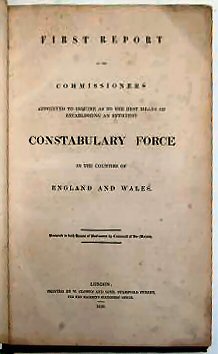
First Report Of The Commissioners Appointed To Inquire As To The Best Means Of Establishing An Efficient Constabulary Force, In The Counties Of England And Wales.
together With.
Bound in contemporary half-calf over marbled boards. Contrasting title label, lettered gilt. A trifle worn at extremities but a very good copy.
£300.00
Publisher
W. Clowes, London:,
Date
1839 and 1850.
Synopsis
Report from the select committee on postal communication between london and paris.
Item Description
Folio. vi + 255 pp. and xxii + 299 pp.
Notes
POLICE :-
Edwin Chadwick (1800-1890), one of the nineteenth century's great reformers, and Charles Rowan, chief commissioner of the new Metropolitan Police, conducted this inquiry into the means of improving police protection and getting at the 'removable antecedents of crime.' It was Chadwick who also conducted the groundbreaking inquiry (PMM 313) into sanitary conditions in 1842 which led to tremendous advances in public health reform.
POST :-
'Select Committee appointed to ascertain the most expeditious and least expensive mode of postal communication between London and Paris and the Northern parts of Europe'... (p.iii).
The report comments on the lateness of mails between London and Boulogne via Folkestone, this route having temporarily replaced the Dover to Calais route. The two routes and respective harbour facilities are then compared. The Committee concluded that the Boulogne route remained the most expensive and stated that 'risk of serious accident to the packets is greater.... [and] that Calais could not well be superceded' (p.v). The Committee recommended that trains from Dover to London be accelerated and noted delays in day mails from Paris. Proceedings include a fuller draft report. 36 witnesses appeared before the Committee on 10 days of evidence session held between March and May 1850. 1,861 questions related to the mails, their organisation, times and procedures involved and overall efficiency (of railways and steam packets). These questions were put to British and French postal officials, railway and ship workers associated with the mail service. A further 275 questions were put to Parliamentary clerks, newspaper proprietors and officials connected with the printing of Parliamentary papers (including Henry Hansard). These largely related to the procedures linked to the aforementioned breach of privilege. Appendices (110 pages) include correspondence, documents and statistics relating to the Paris to London mail service.
[Stock No. 16055]


Subjects
19th Century • British • Commerce • Kent • Law • Local Government