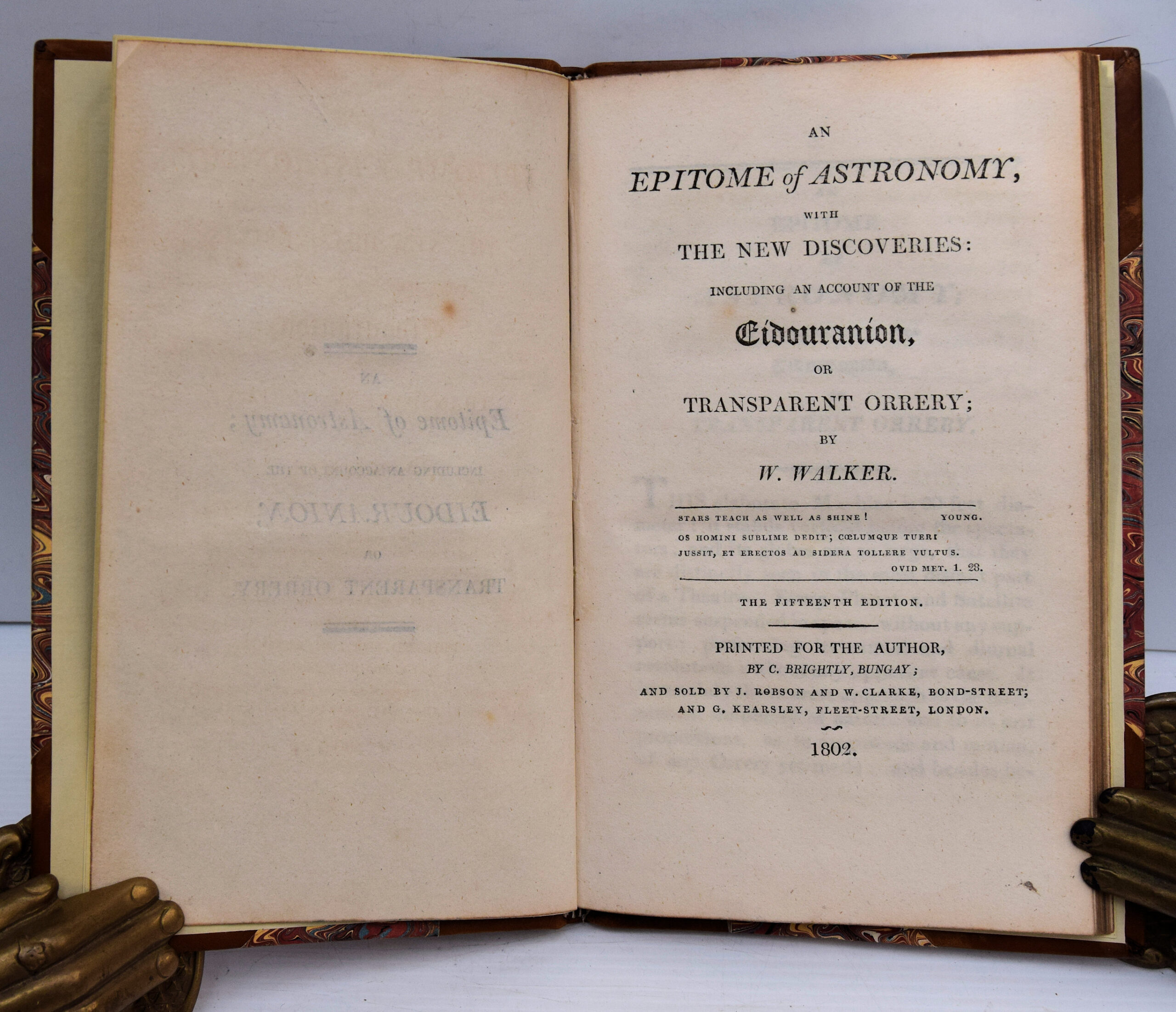
An Epitome Of Astronomy, With The New Discoveries: Including An Account Of The Eidouranion, Or Transparent Orrery;.
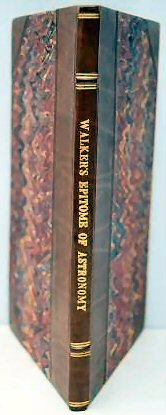
Bound in later half calf over marbled boards. Spine divided into compartments by raised bands and gilt rules A fine clean copy.
£250.00
Publisher
Printed for the Author, by C. Brightly, Bungay; and sold by J. Robson and W. Clarke, Bond-Street; and G. Kearsley, Fleet-Street, London.,
Date
1802
Synopsis
By w. walker. the fifteenth edition.
Item Description
8vo. 5 x 8 inches. [iv] + 43 pp. + [1] advertisements. Illustrated by tailpiece vignette.
Notes
'This elaborate Machine is 20 feet diameter: it stands vertical before the spectators; and its globes are so large, that they are distinctly seen in the most distant part of a Theatre. Every Planet and Satellite seems suspended in space, without any support; performing its annual and diurnal revolutions without any apparent cause.' The Epitome served as accompanying guidebook to the demonstrations of this 'transparent orrery, which stood the Walker family in good stead for fifty years' (DNB). The orrery was devised by Adam Walker (1730-31) a self-taught schoolmaster from a Westmorland wool manufacturing family, who had developed his mechanical skills by building models of various types of mills. He became an itinerant lecturer based at York, before moving to London where he lectured in Conduit Street (see advertisement at end of book). He continued to travel and lecture to artisans and was also aquainted with several members of the Lunar Society. Walker filled the Theatre Royal, Haymarket with a staged performance of his orrery, accompanied by the music of a mechanical harpsichord he had patented in 1772. The first edition of this work appeared in 1782 as 'An Account of the Eidouranion, or Transparent Orrery', under Adam's name. William Walker (c.1766-1816) was his eldest son who, after education at Eton as a king's scholar, 1778-80, joined his father on the lecture circuit. By the thirteenth edition (1798) of the Epitome, as it was now called, his name had replaced that of his father on the title page. After William's death, the third son, Deane Franklin (1778-1865) continued the demonstrations and editorship of the family publications. Thirty-one editions of the Epitome had appeared by 1824. A fine copy of this fifteenth edition, recorded by COPAC only in the British Library, Oxford and Glasgow.
[Stock No. 20658]


Subjects
19th Century • Astronomy • Natural History/Science • Physics • Science